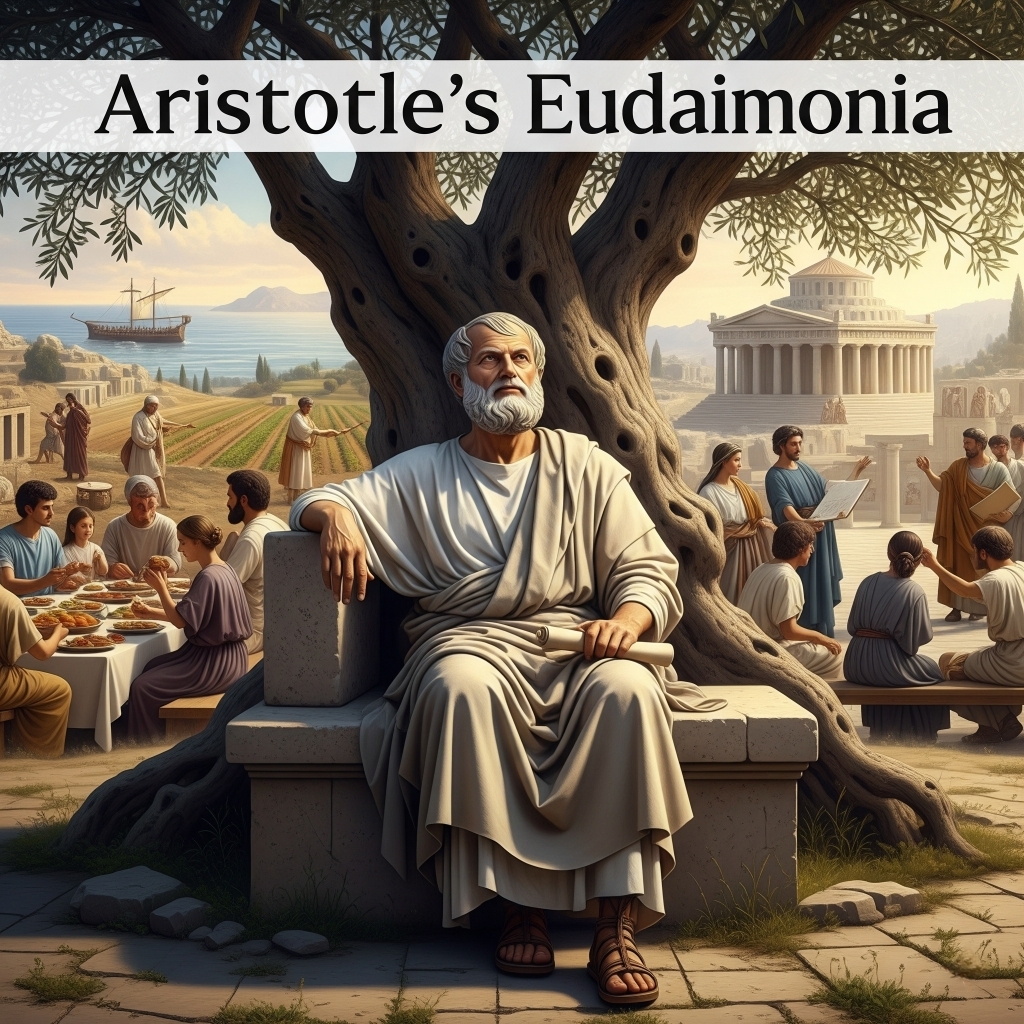
Does Aristotle have a coherent account of flourishing (eudaimonia) in the Nicomachean Ethics?
Aristotle's account of eudaimonia in the Nicomachean Ethics presents an apparent tension between the contemplative ideal of Book X and the emphasis on moral and practical virtues in Books II-IX. This essay argues that despite this tension, Aristotle's account maintains philosophical coherence through its sophisticated integration of intellectual and moral excellence as different but complementary manifestations of human flourishing.
The foundation of Aristotle's account rests on his Function Argument, which establishes the essential connection between human nature and flourishing. By identifying reason as humanity's distinctive function, Aristotle argues that human flourishing must involve excellence in rational activity. This initial presentation of eudaimonia characterizes it as an activity of the soul in accordance with virtue, the most complete and self-sufficient, constituting the highest good for human beings. This foundation is crucial as it establishes both the importance of moral virtue and practical wisdom while also setting up the potential for contemplative activity as the highest fulfillment of human nature. The Function Argument provides a unified framework within which different aspects of human excellence can be understood and evaluated.
However, a significant tension appears to emerge between different parts of the Nicomachean Ethics. Throughout Books II-IX, Aristotle develops a rich account of moral virtue, practical wisdom, and political engagement, suggesting that human flourishing involves excellence in practical affairs and moral character. In contrast, Book X appears to elevate contemplative activity (theoria) as the highest form of happiness, potentially undermining the significance of moral virtue and practical wisdom. This apparent contradiction raises several problems: how can we reconcile the different emphases on practical versus theoretical activity? Is moral virtue intrinsically valuable, or merely instrumental to achieving contemplative excellence? How can we understand the relationship between human limitations and the divine ideal of pure contemplation?
John Cooper's influential interpretation offers a promising resolution through his "bipartite" conception of eudaimonia. According to this reading, Aristotle recognizes two legitimate paths to human flourishing, arranged in a hierarchy that preserves both the contemplative ideal and the value of the mixed life. This interpretation suggests that while contemplative activity represents the highest form of happiness, a life combining moral and intellectual virtues constitutes a genuine, if secondary, form of human flourishing.
However, the concept of "secondary happiness" raises significant philosophical challenges that deserve careful examination. One might object that designating practical wisdom and moral virtue as "secondary" undermines their intrinsic value and reduces them to mere instruments for achieving contemplative excellence. This objection gains force when we consider Aristotle's emphasis on the self-sufficient nature of happiness – if secondary happiness depends on external conditions and relationships in ways that contemplation does not, can it truly qualify as eudaimonia?
In response, we can argue that Aristotle's hierarchy of formes of life does not diminish the genuine value of practical wisdom and moral virtue, but rather recognizes different modes of excellence appropriate to our complex nature as both rational and social beings. The relationship between practical wisdom and contemplation is not merely instrumental but integrative. Practical wisdom (phronesis) contributes to contemplative activity in several crucial ways: it helps us recognize opportunities for theoretical pursuit, maintains the conditions necessary for sustained contemplation, and develops the intellectual virtues that make philosophical insight possible. Moreover, practical wisdom itself involves a kind of theoretical understanding applied to human affairs, suggesting a deeper connection between practical and theoretical excellence than a purely hierarchical model might suggest.
Another significant objection concerns the accessibility and practicality of Aristotle's contemplative ideal. If the highest form of happiness is available only to a select few who can engage in sustained philosophical contemplation, does this render Aristotle's ethical theory fundamentally elitist or impractical? Furthermore, given our nature as embodied, social beings, is the pursuit of pure contemplation even desirable as a life goal?
These objections can be addressed by examining how Aristotle's account accommodates human limitations while maintaining aspirational ideals. The divine model of pure contemplation serves not as an exclusive standard but as a guiding ideal that helps us understand the rational dimension of human nature. Different individuals may realize this ideal to varying degrees based on their circumstances and capacities, without invalidating the genuine happiness they achieve through practical excellence. This reading preserves both the objective standard of human flourishing and the flexibility to recognize different paths to happiness.
The relationship between contemplation and practical life can be further illuminated by considering how they mutually reinforce each other. Moral virtue creates the character stability necessary for sustained theoretical activity, while contemplation enriches practical judgment by providing broader perspective and deeper understanding of human nature. This suggests that rather than viewing practical and contemplative activities as competing alternatives, we should understand them as complementary aspects of complete human flourishing.
The political dimension of Aristotle's ethics adds another layer to this integration. While contemplation might seem to pull us away from political engagement, Aristotle's account suggests that political wisdom and philosophical insight are interconnected. The politically engaged person develops practical wisdom that can inform theoretical understanding, while philosophical contemplation can enhance political judgment by providing insight into human nature and the good life.
In conclusion, while Aristotle's account of eudaimonia presents certain tensions, particularly between contemplative and practical aspects of human life, it maintains an underlying coherence through its sophisticated understanding of human nature and flourishing. The apparent contradictions can be resolved by recognizing how different aspects of human excellence – contemplative, moral, and practical – work together in creating a complete life. This interpretation not only preserves the philosophical sophistication of Aristotle's account but also highlights its enduring value for contemporary discussions of human flourishing. His recognition that different individuals might legitimately pursue different paths to happiness, while maintaining objective standards of human excellence, offers important insights for modern ethical reflection. Rather than seeing the tensions in Aristotle's account as weaknesses, we can understand them as reflecting the complexity of human nature and the challenge of integrating different aspects of human excellence into a coherent vision of the good life.
